The Fourth Pillar: Why Procurement Partnerships Matter More Than Ever
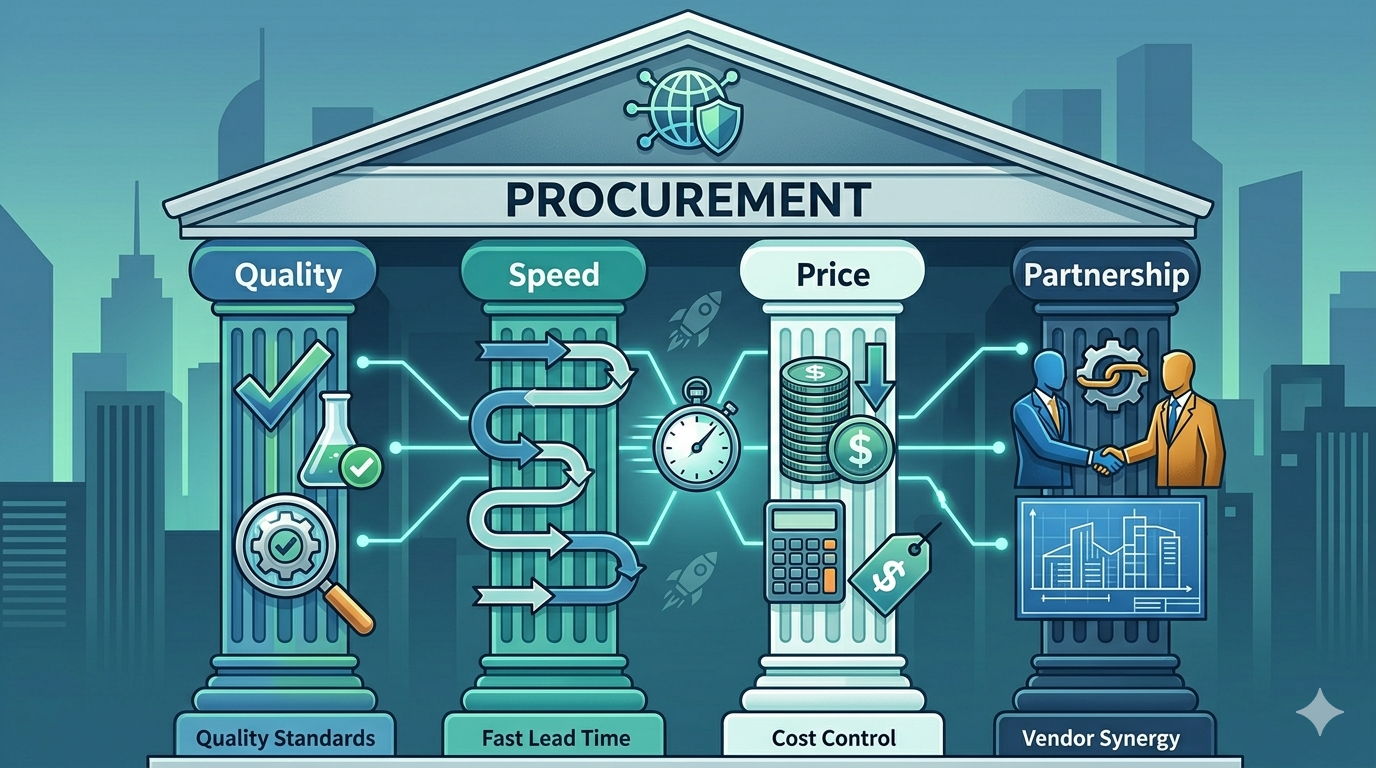
For many years, procurement success was measured by three familiar pillars: quality, speed, and cost. Hit your specs. Meet your lead times. Protect your margins. In a stable environment, that model works. But we’re no longer operating in stable times. Volatility is no longer a temporary disruption that manufacturers can plan around—it’s become the operating baseline. And when conditions change quickly, transactional supplier relationships tend to fail in the most painful way possible: line-down situations. That’s why the three-pillar framework is expanding. The most resilient manufacturers aren’t just sourcing parts. They’re building procurement partnerships—and treating them as a fourth pillar that protects the other three.
The Limits of the Traditional Procurement Model
Quality, speed, and cost are still essential. Nothing in manufacturing works without them. But those pillars are mostly optimized for “business as usual.” When things don’t go as planned, the relationship often has no shock absorber, no shared plan for disruption, and no flexibility for substitutions. There’s also no incentive to prioritize your business continuity when the supplier is under pressure from other customers, upstream constraints, or margin compression. That’s the gap manufacturers feel today. The issue isn’t that procurement teams are doing the wrong work. It’s that the old scorecard doesn’t fully measure continuity—which sits at the core of modern supply chain resilience.
Why Volatility Exposes Transactional Weakness
Volatility doesn’t just raise costs. It changes what “good sourcing” even means.
 When feedstocks tighten, when transportation delays stack up, or when a material grade becomes scarce, transactional suppliers tend to point back to the contract. That’s rational. It’s also rarely helpful when a production line is hours away from going down.
Modern manufacturing can’t assume predictability. The shocks keep coming—tariff uncertainty, supply chain surprises, geopolitical tension, and more. In that reality, procurement models built purely for efficiency are increasingly fragile. You don’t feel the weakness in a spreadsheet. You feel it when a buyer is scrambling, engineering is stuck waiting on a material, and operations is watching the clock. That’s when procurement stops being just a purchasing function and becomes a risk-management function.
Partnership as the Fourth Pillar of Procurement
Partnership isn’t a feel-good label. It’s a procurement strategy. A true strategic partner does more than fulfill orders. They help you protect uptime by thinking beyond the PO. For example:
- What happens if the primary resin isn’t available next month?
- What happens if a tooling change is required under a tight deadline?
- What happens if demand spikes and capacity needs to shift fast?
Partnership becomes the fourth pillar because it keeps quality, speed, and cost from collapsing under stress. And the manufacturers doing this best don’t treat partnership as something you “earn after years.” They plan for it early, they build a vetted network, and they evaluate suppliers not only on what they can deliver today, but how they behave when something goes sideways.
How Strategic Partners Act as a Procurement Hedge
When feedstocks tighten, the difference between a supplier and a strategic partner becomes clear. A transactional supplier delivers what’s specified—or extends lead times when materials aren’t available. A strategic partner looks for ways to keep production moving.
 That often means identifying alternative material grades that meet functional requirements, validating performance impacts quickly, and coordinating testing or approvals without slowing everything down. Instead of treating material constraints as a dead end, partners treat them as a problem to solve.
In volatile markets, that flexibility becomes a hedge. Manufacturers with partners who understand materials, applications, and downstream requirements are better positioned to adapt without shutting down lines or scrambling for last‑minute solutions.
This kind of flexibility doesn’t happen by accident. The manufacturers best positioned for volatility don’t scramble for solutions mid‑crisis. They invest early in vetted partners, redundancy where it matters most, and relationships tested under real‑world pressure. By treating continuity as a design requirement—not an afterthought—they turn procurement into a stabilizing force instead of a vulnerability when conditions shift.
What Partnership Looks Like with New Berlin Plastics
At New Berlin Plastics, we work with OEMs and tiered suppliers who don’t just need molded parts—they need predictability. That requires more than transactional execution. It requires a partner mindset built around stability, communication, and repeatable performance.
Our team emphasizes design for manufacturing, mold-flow analysis, scientific injection molding, and upstream engineering support to help manufacturers protect quality while staying agile under pressure. And because continuity depends on trust, we focus on transparency and accountability—especially when there’s a challenge to solve, not just an order to ship. In other words, we aim to be more than a supplier. We aim to be part of your resilience plan.
Procurement as a Competitive Advantage
Quality, speed, and cost still matter. But today, those pillars aren’t enough. Procurement is evolving because the risks have evolved. Procurement partnerships have become essential to supply chain resilience, turning sourcing from a transaction into a strategy.
If you’re ready to build a procurement strategy designed for resilience, New Berlin Plastics is ready to help. Contact us today.