Safeguarding the Blueprint: Why Intellectual Property Security Is Sourced, Not Just Contracted
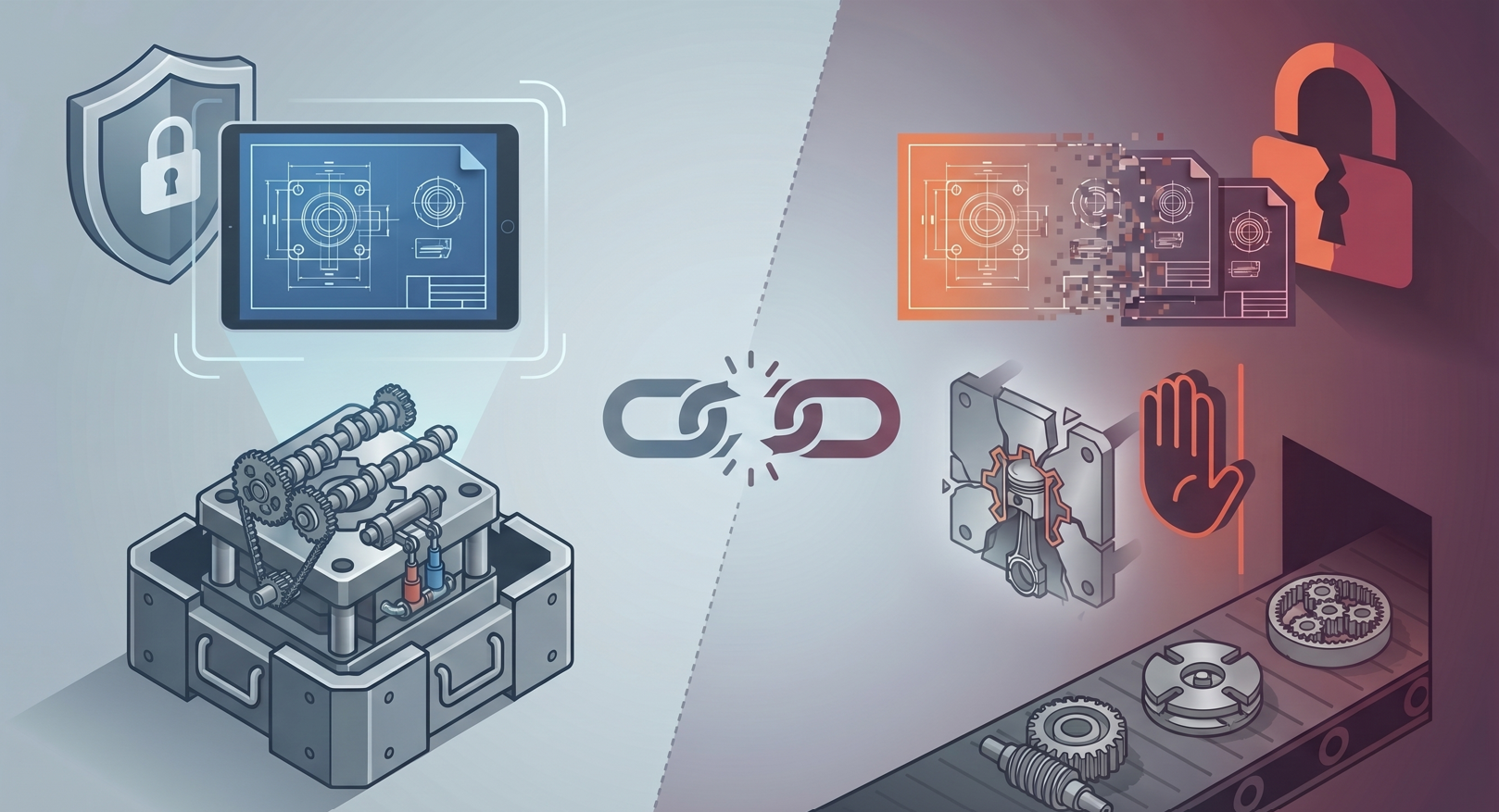
Offshoring can seem like a straightforward math problem: lower piece price, acceptable lead time, quality checks out—sign the agreement and move forward. But for many manufacturers, that equation breaks down the moment intellectual property (IP) becomes part of the value.
IP risk doesn’t show up as a line item on an invoice. It shows up as a delayed launch. A “missing” tool. A supplier that suddenly becomes uncooperative. Or a suspiciously similar part entering the market. These situations are especially difficult to resolve when production happens in countries where legal agreements are hard to enforce. Even strong contracts and NDAs can lose their power if resolving a dispute takes years, costs more than the project itself, or simply isn’t realistic across borders. U.S. trade agencies regularly note that IP protection and enforcement vary widely depending on where manufacturing occurs—and problems become more common as supply chains stretch across multiple countries.
The takeaway is straightforward: protecting intellectual property isn’t just about what you put in a contract. It’s also about where you choose to manufacture and who you trust with your designs and tooling. In other words, IP security isn’t just negotiated—it’s sourced.
When IP Risk Becomes an Operational Problem
Most manufacturers don’t think about IP security until something breaks. That’s understandable. IP is often treated as a legal issue—handled by counsel and buried in contract templates. In reality, the consequences show up elsewhere first.
If a design is copied, a process is replicated, or a tool is withheld, it’s not your legal team that feels the impact. It’s your production planners. It’s your customer service team managing missed ship dates. It’s your engineers scrambling to redesign around a bottleneck that never should exist in the first place. Just imagine: Suddenly you see a dip in demand, only to find a competitor offering a lower-cost version of your product.
This is what makes IP different from many other risks. The disruption is immediate and the remedy is often slow. In today’s global supply chains, enforcement across borders adds another layer of complexity—one that manufacturers typically confront only after operations have already been affected.
Tooling is Leverage—and Location Determines Who Controls It
In injection molding and other precision manufacturing processes, tooling isn’t just an asset. It’s leverage. Whoever controls the mold controls the schedule, the output, and—too often—the relationship.
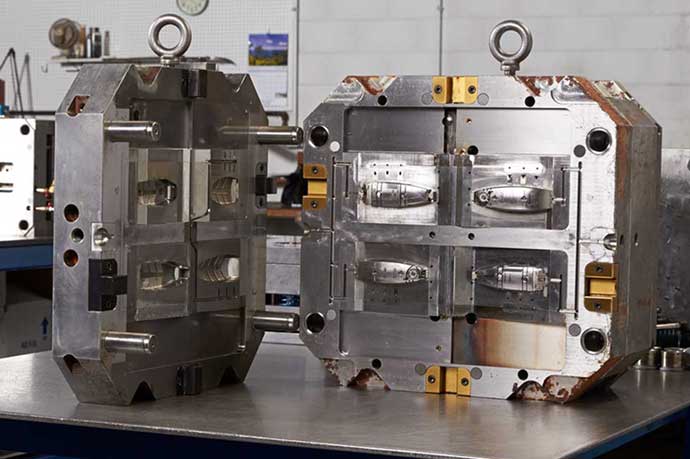 In offshore scenarios, tooling disputes can escalate quickly. You may have paid for the mold. You may have documentation confirming ownership. You may even have contract language requiring its return. Yet it’s still possible to face delays, restricted access, unexpected “release” fees, or outright refusal to transfer the tool.
These scenarios highlight a critical reality—ownership on paper doesn’t always translate to control in practice. This is where the difference between contracted and sourced IP security becomes clear. In high‑stakes manufacturing, protection isn’t defined only by what your agreement says. It’s defined by what your supplier can be held accountable to and what you can realistically enforce.
For Complex Components, the Design Is the Asset
Not every part carries the same level of risk. But as components become more complex, the value often extends well beyond the finished piece.
In these cases, the real IP lives in the decisions behind the part. For example, how it was designed to function, how tight tolerances were achieved, or how the tooling was engineered to run consistently. Those details reflect years of experience, iteration, and problem‑solving. Once that knowledge slips outside your control, there’s no easy way to take it back.
This is especially true for high‑precision components with long product lifecycles. When design files, tooling concepts or process knowledge aren’t well protected, competitors don’t just see the part—you’ve shown them how to make it work. That shortens the gap between innovation and imitation. For complex programs, protecting IP isn’t just about preventing copies. It’s about protecting the expertise that makes reliable production possible in the first place.
What It Means to Source IP Security
Protecting intellectual property isn’t just about legal language. It’s about how your supply chain is built, where you manufacture, who has access to your designs, and how tightly production is managed. When sourcing decisions don’t account for enforcement, visibility, and leverage, even strong contracts can fall short when problems arise.
That’s why IP protection starts long before the contract phase. It begins with choosing partners and locations that reduce risk by design. Suppliers operating under predictable legal frameworks, with clear accountability and disciplined internal controls, make it easier to safeguard designs, tooling, and process knowledge.
Protect the Blueprint, Protect the Business
At New Berlin Plastics, we work with OEMs and tiered suppliers who don’t just need parts. They need confidence that their blueprints stay protected and production stays stable. That’s why we focus on building security into our relationships and workflows—not just the paperwork.
If you’re evaluating a new source for molded components—or reconsidering an offshore setup that feels increasingly exposed—start with one question: is this supplier set up to protect your blueprint in practice, not just on paper? Because in the end, intellectual property security isn’t just contracted. It’s sourced.
Looking for an injection molding partner you can trust? Contact New Berlin Plastics today.