When Fast Innovation Creates Slow Production
Companies have never moved faster. Product teams are launching new products, responding to customer feedback, and accelerating development cycles at a pace that would’ve been difficult to imagine just a decade ago. Yet many manufacturers are discovering a frustrating reality: the faster they innovate, the harder it can become to scale production.
Products often move quickly through concept development and prototyping, only to encounter delays when it’s time to build tooling, validate processes, and begin full-scale manufacturing. Tooling modifications, material challenges, process limitations, and late-stage design changes can turn a fast-moving project into a slow-moving launch. The problem isn’t innovation itself. The problem is that product development and manufacturing often move at different speeds.
When manufacturing considerations aren’t incorporated early enough, OEMs can unintentionally trade schedule risk for production risk. The result is a project that appears to be moving quickly—right up until manufacturing realities catch up with it. In many cases, the missing ingredient is manufacturing readiness: the ability to transition a product from development into scalable production with minimal disruption.
Why Great Product Ideas Sometimes Stall
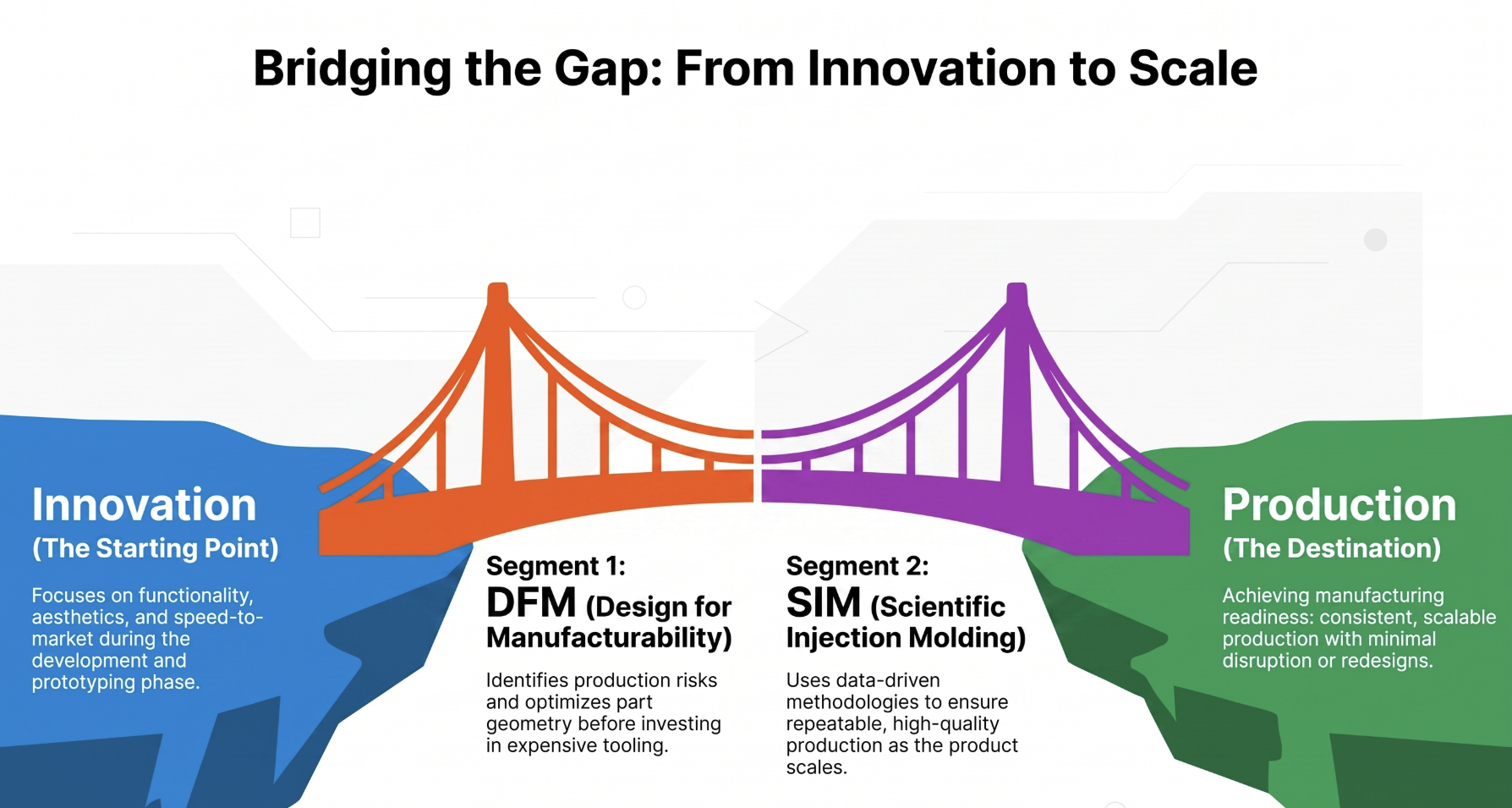
During product development, teams are understandably focused on creating a product that works. The priorities are functionality, performance, aesthetics, and speed to market. Manufacturing teams face a different challenge: producing that same product consistently, efficiently, and at scale. Those objectives support one another, but they aren’t always evaluated at the same time.
As a result, product teams can reach a successful prototype or design milestone while unknowingly creating production challenges that emerge later. Minor design decisions can affect moldability, tooling complexity, cycle time, material flow, or long-term process stability. These issues may not be visible during development, but they become increasingly apparent as production approaches.
A prototype proves a product can function. It does not prove it can be manufactured efficiently at production volumes or that it is ready for scale. True manufacturing readiness requires evaluating how a product will perform in real-world production conditions. That’s why products that move quickly through development can sometimes slow dramatically as they approach launch.
The Cost of Discovering Manufacturing Challenges Too Late
Manufacturability concerns rarely remain isolated to engineering. When production challenges emerge after tooling is built or validation is underway, organizations often face a ripple effect of consequences. Launch schedules slip. Tooling costs increase. Resources are redirected to solving issues that could have been identified much earlier in development.
For organizations under significant speed-to-market pressure, these delays can be particularly frustrating. The effort invested to accelerate innovation can be undermined by production challenges that were not considered during the design phase. The later a problem is discovered, the more expensive and disruptive it typically becomes to correct.
This is why many OEMs are rethinking how product development and manufacturing teams collaborate. Rather than treating manufacturing as the final step in development, they are bringing manufacturing expertise into the process much earlier.
Key Takeaways: Manufacturing Readiness
Q: What is manufacturing readiness?
A: Manufacturing readiness is the ability to move a product from development into scalable production with minimal disruption. It requires validating not only product performance but also tooling, materials, processes, and production requirements.
Q: Why do products sometimes stall during production scale-up?
A: Products often move quickly through development and prototyping but encounter tooling, process, or manufacturability challenges when production volumes increase. A successful prototype does not automatically mean a product is ready for large-scale manufacturing.
Q: What role does manufacturing scalability play in product development?
A: Manufacturing scalability should be considered throughout development, not after validation is complete. Early decisions about materials, tooling, and part design can significantly impact future production performance and capacity.
Q: How does Scientific Injection Molding support manufacturing readiness?
A: Scientific Injection Molding uses data-driven process development to improve repeatability, reduce variation, and create more predictable production outcomes as a product moves from launch to scale.
Q: How does New Berlin Plastics help OEMs improve manufacturing readiness?
A: New Berlin Plastics helps OEMs align product development with manufacturing realities through design for manufacturability, mold flow analysis, resin selection support, and Scientific Injection Molding practices that reduce risk and support successful product launches.
Why Design for Manufacturability Matters
 This disconnect is one reason design for manufacturability has become increasingly important. Too often, manufacturability is treated as something to evaluate after a design is complete. By that point, teams may already be committed to decisions that increase tooling complexity, limit process flexibility, or create unnecessary production risk.
Design for manufacturability (DFM) shifts those conversations earlier. It evaluates how part geometry, material selection, tooling requirements, and production realities interact before investments in tooling and production are made. A structured DFM approach helps manufacturers:
- Identify production risks earlier
- Improve tooling feasibility
- Reduce unnecessary complexity
- Minimize redesigns
- Improve production efficiency
- Support a smoother product launch
Most importantly, it helps teams make informed decisions before those decisions become expensive to change.
Manufacturing Scalability Starts Earlier Than Most Teams Think
Many OEMs think about scalability after a product has been validated. But in truth, manufacturing scalability is influenced by decisions made throughout development. Material behavior, cooling requirements, cycle times, tooling design, and process consistency all become increasingly important as volumes grow. A product that performs well during prototyping may require significant adjustments before it can be produced efficiently and predictably at scale.
Successful manufacturers recognize that scalability isn’t simply a production concern—it’s a development consideration. By evaluating manufacturing requirements early, teams can maintain innovation velocity without introducing unnecessary friction later in the product lifecycle.
The Role of Scientific Injection Molding
Even when a design is optimized for manufacturing, success ultimately depends on process consistency. That’s where Scientific Injection Molding becomes critical.
Scientific Injection Molding uses data-driven methodologies to establish robust, repeatable production processes. Rather than relying on trial and error, manufacturers develop a deeper understanding of how material, tooling, and process variables interact during production. This approach helps create:
- More consistent part quality
- Greater process repeatability
- Reduced variation across production runs
- Improved production efficiency
- Increased confidence during scale-up
As production volumes grow, these advantages become increasingly important. Innovation may drive the original concept, but repeatability is what enables long-term manufacturing success.
Bridging the Gap Between Innovation and Production
The most successful product launches don’t happen because development teams move slower. They happen because development teams and manufacturing teams move together. When engineering, tooling, materials, and production considerations are aligned early, organizations can innovate quickly without sacrificing manufacturability or scalability. The result is fewer surprises, fewer redesigns, and a more predictable path to production.
That’s where New Berlin Plastics can help. Our team works with customers early in the development process through design for manufacturability, mold flow analysis, resin selection support, and scientific injection molding practices. Rather than treating manufacturing as the final step in development, we help integrate production realities into the process from the beginning.
By identifying risks before tooling is built and validating designs against real-world manufacturing conditions, we help customers improve manufacturing readiness, maintain development velocity, and create a stronger foundation for a successful product launch. In fact, New Berlin Plastics has an on-time delivery rate of 97.3% and a customer acceptance rate of 99.8%.
Keep Your Next Product Launch Moving Forward
Whether you’re developing a new product, preparing for a tooling transfer, or evaluating ways to improve manufacturing scalability, early manufacturing collaboration can help reduce risk and improve outcomes. Talk with our team!