The ‘Cheapest Part’ Illusion: Looking Beyond Piece Price in Plastic Injection Molding
Cost pressure is not new to manufacturing, but the intensity has changed. Inflation, margin compression, tariff uncertainty, and ongoing supply chain volatility have forced many OEMs to examine every sourcing decision more closely. In that environment, it’s natural for procurement teams to focus on the number that is easiest to compare: piece price. But is the lowest-priced part always the lowest-cost part?
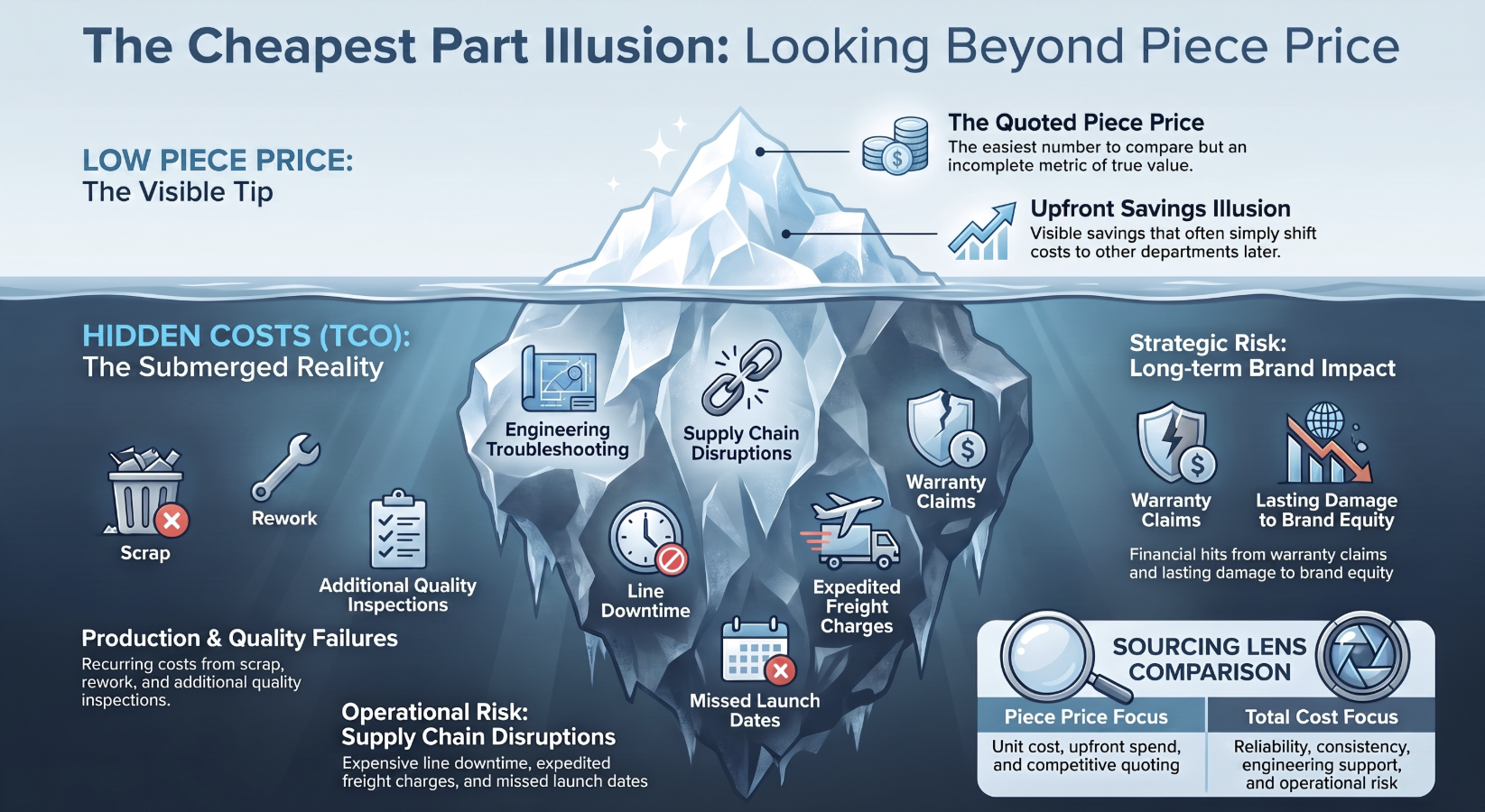
Not necessarily. A quote can tell you what a component costs to purchase, but it rarely shows what that component costs to own. The true cost often appears later through quality issues, added inspections, production delays, rework, missed launches, and lost uptime.
That’s the illusion of the “cheapest part.” While it may reduce upfront spend, downstream factors like variability, quality issues, and operational risk can quickly erase the savings. For OEMs, the better question is not which supplier offers the lowest price, but which delivers the lowest total cost of ownership.
Why Piece Price Doesn’t Tell the Whole Story
Piece price matters. Every manufacturer needs to control costs, protect margins, and remain competitive. Procurement teams are often measured on their ability to reduce spend, and competitive quoting creates a clear side-by-side comparison. That makes piece price a useful metric. It is also an incomplete one.
A quoted part cost reflects what a supplier charges to produce a component under a defined set of assumptions. It doesn’t always account for how consistently that part will perform in production, how often it will require inspection, how easily it will assemble into the final product, or how much support will be needed if issues arise. Those factors matter because a part does not exist in isolation. It moves through receiving, inspection, assembly, packaging, inventory, shipment, and customer use. When a component creates friction at any stage, the cost extends beyond the purchase order.
Upfront savings can simply shift costs elsewhere. Engineering, quality, and production teams may spend additional time addressing issues that were never reflected in the original quote. The savings are visible. The exposure often isn’t.
The Hidden Costs That Show Up Later
The most expensive part of a low-cost sourcing decision is often what’s not included in the quote. A component that saves a few cents per piece can become costly if it creates recurring quality concerns or production interruptions. Those costs can appear in several ways:
- Scrap and rework
- Additional quality inspections
- Line downtime
- Engineering troubleshooting
- Expedited freight
- Delayed shipments
- Missed launch dates
- Damage to brand equity
- Warranty claims
- Administrative time spent managing supplier issues
Key Takeaways:
Q: What is total cost of ownership in plastic injection molding?
A: Total cost of ownership includes not only the purchase price of a component but also the costs associated with quality, reliability, delivery performance, supplier support, and operational risk
Q: Is the lowest-priced part always the lowest-cost part?
A: No. A low piece price may reduce upfront spend, but quality issues, production delays, rework, inspections, and downtime can quickly increase the true cost of ownership.
Q: What hidden costs can result from choosing the lowest quote?
A: Hidden costs can include scrap, rework, additional inspections, engineering troubleshooting, line downtime, expedited freight, missed launch dates, damage to brand equity, and warranty claims.
Q: How does design for manufacturability help reduce costs?
A: Design for manufacturability identifies opportunities to improve moldability, reduce complexity, increase consistency, and prevent costly production issues before manufacturing begins.
Q: What should OEMs evaluate besides piece price?
A: OEMs should evaluate supplier reliability, process consistency, engineering support, quality performance, communication, and the supplier’s ability to reduce long-term operational risk.
Individually, these may seem manageable. Together, they can quickly outweigh the on-paper savings. In plastic injection molding, consistency depends on process control, material selection, tooling condition, and part design. When your repeatability suffers, your customer absorbs the cost through disrupted schedules, added labor, and operational inefficiencies.
For OEMs, this is where total cost of ownership becomes critical. The price of a part should be evaluated alongside the cost of risk. A slightly higher purchase price may deliver greater value if the part arrives on time, meets specifications, performs consistently, and supports uninterrupted production.
Consistency Is More Valuable Than It Looks
What is the value of a production run that performs exactly as expected? For manufacturers, consistency is more than a quality goal—it’s a cost-control strategy. Consistent parts reduce variability, support throughput, and help teams meet delivery commitments with confidence.
When parts perform predictably, fewer resources are spent on troubleshooting and rework. Quality, engineering, and operations teams can focus on improvement instead of problem-solving. That predictability becomes especially valuable when schedules are tight and customer expectations are high.
This’s why the lowest-cost part is not always the best total cost of ownership decision. Suppliers that deliver consistency, transparency, and process discipline help reduce operational risk, improve supply chain resilience, and support long-term performance.
At New Berlin Plastics, we view reliability as part of the value we provide. Our customers depend on components that meet requirements consistently throughout the life of a program because consistent production is what protects their operation.
The Best Cost Reduction Happens Before Production Begins
Many of the most effective cost-saving opportunities are identified before production ever starts. Part design, material selection, tooling strategy, and processing requirements all influence long-term cost. When these factors are evaluated early, manufacturers can reduce complexity, improve consistency, and avoid issues that drive costs higher later.
This is where design for manufacturability creates value. By reviewing a part through the lens of production, engineering teams can identify opportunities to improve moldability, support repeatability, and minimize quality risks before they affect the shop floor. The goal is not simply to lower piece price—it’s to reduce total cost of ownership.
At New Berlin Plastics, we work with customers early in development to improve manufacturability and reliability. Small design adjustments can reduce scrap, improve throughput, and prevent costly issues long after launch. By the time a quote reaches a sourcing team, many of the biggest cost drivers are already established. That is why the most meaningful cost reductions often begin long before a part enters production.
Strategic Partners Help Reduce Total Cost of Ownership
Strategic supplier partnerships help manufacturers make better sourcing decisions by looking beyond the number on the quote. The right partner brings engineering expertise, process discipline, and clear communication to the table—helping OEMs evaluate not just what a part costs, but what it may require over the life of a program.
The lowest quote may not include that level of support. When evaluating suppliers, OEMs should consider how well a partner manages quality, responds to challenges, and supports long-term production goals. Those capabilities can help prevent costs that never appear on a purchase order but still affect margins, schedules, and customer satisfaction.
Look Beyond the Lowest Number
The “cheapest part” can create a false sense of savings. While a lower piece price may reduce upfront costs, it does not guarantee lower total cost. Strong sourcing decisions weigh price against the factors that shape long-term value—including manufacturability, supplier support, quality, and operational risk.
At New Berlin Plastics, we help customers evaluate the full picture through reliable processes, transparent communication, and plastic injection molding solutions built for lasting performance.
Looking beyond purchase price starts with asking the right questions. Contact New Berlin Plastics to learn how we help customers reduce risk, improve consistency, and optimize total cost of ownership.